02 Mar 2026
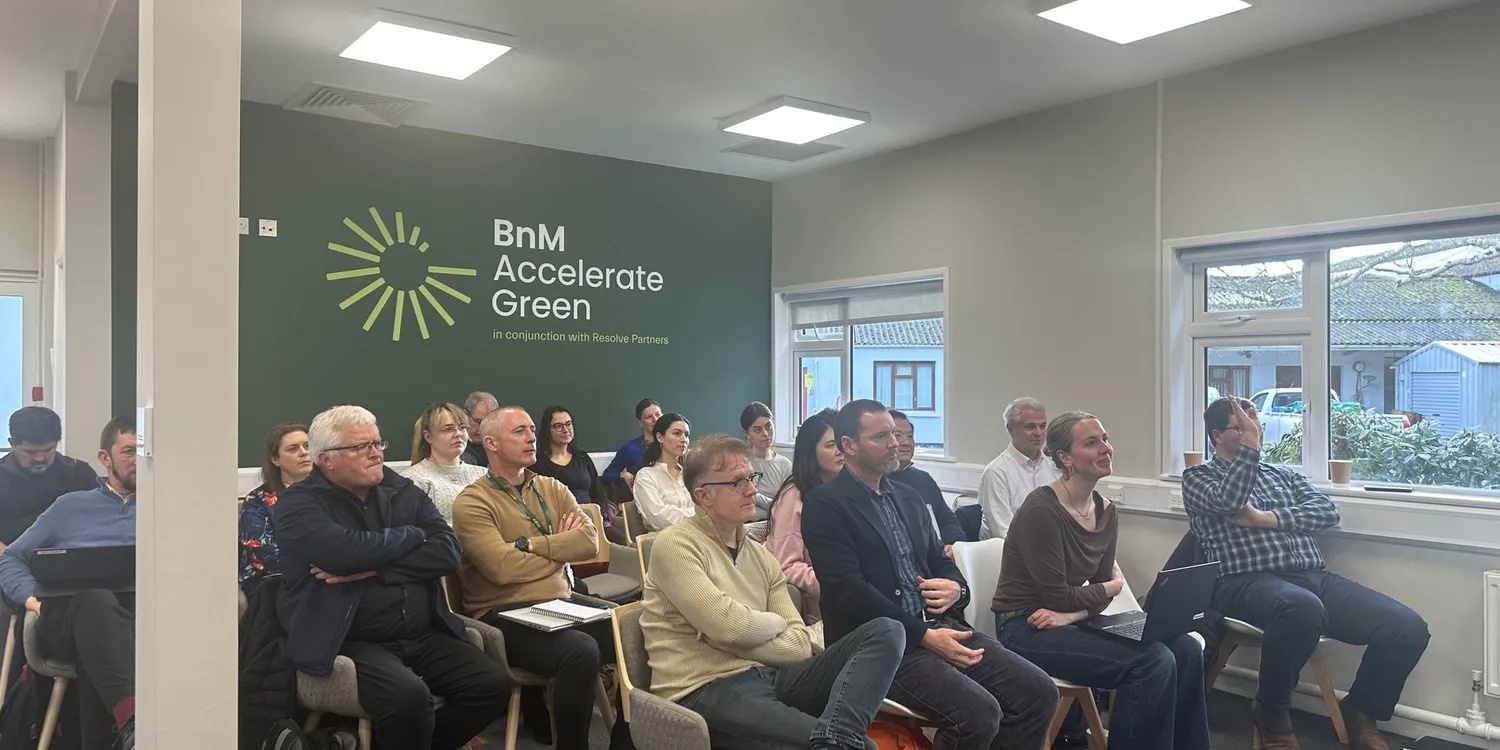
On Thursday, February 19, 2026, the Peatlands and People project held its annual EPA researcher meeting. The meeting brought together scientists from several EPA projects, which inform the implementation, impacts and monitoring of the Peatlands and People project.
From satellite monitoring of Water Table Depth (WTD) to new insights on methane emissions and the exciting start of a new project, AIMINGPEAT, the projects highlighted innovative research on managing Ireland's peatlands in a way that maximises their potential for climate mitigation.
Below are some key highlights from the day!
🤝 Link to Policy: The EPA licenses 9 Bord na Móna (BnM) sites, all with detailed rehabilitation plans. Research outputs from the EPA-funded projects contribute to policy, such as the National Restoration Plan, the National Peatlands Strategy update, the Climate Action Plan and Water Framework Directive (WFD) objectives.
🌿Methane Spikes & Plant Influence: Rewetted degraded peatlands can experience methane spikes. In some cases, these methane emissions may temporarily offset CO₂ savings. However, uncertainty remains about how long methane spikes persist after rewetting. Plant species can also strongly influence methane emissions, because methane transport is largely plant-mediated (30–90% via plant pathways). For instance, the plant species Typha latifolia showed much higher methane fluxes at the observed sites than other plant species.
📈 N₂O a Small Emission Contributor: Overall, while N₂O emissions can spike under certain conditions—particularly in transitional or drier systems—they were considered low in magnitude compared to CO₂ emissions, suggesting they are a secondary but still important component of the greenhouse gas balance in peatland restoration contexts.
🛰️Satellite Monitoring of Water Table Depth (WTD) and Scaling Challenge: Satellite data was used to estimate water table depth (WTD) as part of an effort to upscale monitoring. While this worked well at the site-scale, where the satellite-derived WTD data closely matched piezometer field measurements, accuracy drops when attempting to scale regionally. An ongoing question remaining is how to effectively map emission factors from dry vs. wet bare peat at larger scales.
📢New Project AIMINGPEAT: Following the end of the CO2Peat Project, a new project AIMINGPEAT aims to improve carbon dioxide (CO2) and methane (CH4) emission/removal reporting for Irish peatlands and identify effective management interventions, focusing on the main drivers of GHG dynamics, especially in degraded and rehabilitated peatlands. A new exciting PHD opportunity is open on modelling CO2 fluxes as part of the project. Find out how to apply here!
Project Spotlights
🌿Peat Hub Ireland: The completed EPA-funded project worked towards collating evidence to identify knowledge gaps, trends, risks and opportunities for a sustainable future for Ireland’s peatlands. The project’s “Bogland” report informed the National Peatlands Strategy. Some of the most important outputs include: 1) a glossary of terms, 2) a national database of peatland research and 3) policy briefings to guide sustainable peatland management.
🌿Wet-Peat Project: The Wet-Peat project uses state-of-the-art modelling techniques on a representative selection of Ireland’s peatlands to provide insight into how restoration measures may be enhanced. It provides an independent assessment of the BNM PCAS work across five study sites (Castlegar, Ballycon, Clooneeny, Ballaghurt, and All Saints). Researchers from the University of Galway and Trinity College Dublin have been working with satellite data to monitor water table depth. While this worked well at site scale, accuracy dropped at regional scale. The project also developed GIS-based SWMM hydraulic modelling for rewetting structures such as bunds and blocked drains to simulate flows. Field data on seepage and hydraulic conductivity are being fed into these models with the goal to optimise bund and blocked drain performance. The project will share its results towards the end of the year, in December, following the project's end.
🌿CH4Peat Project: The goal of the CH4Peat project, which ended in July 2025, was to quantify methane fluxes and emission factors from two raised and rewetted Irish peatlands. Researchers measured CH4 fluxes and in-situ environmental data from different vegetation microsites (Molinia grass, Sphagnum mosses, Eriophorum, Carex rostrata, Phragmites, Typha and open water) at the Ballycon and Derries peatlands. The findings show that Methane transport is largely plant-mediated (30–90% via plant pathways).
🌿ASPEN Project: The project is working to enhance our knowledge base of nitrous oxide (N2O) emissions from a range of peatland ecosystems. Project findings show that nitrous oxide (N₂O) emissions vary depending on peatland condition and hydrology. Near-natural peatland at Clara bog behaved largely as expected, remaining wetter for most of the monitoring period and sometimes acting as a sink for N₂O, with relatively stable fluxes. In contrast, the drier sites at Cavemount and Ummeras recorded higher N₂O fluxes, with rainfall events triggering emission peaks.
🌿CO2Peat Project: The CO2Peat project ended in 2025 and was dedicated to improving methodologies for reporting and verifying terrestrial CO₂ removals and emissions from Irish peatlands. The project introduced a new tool called the 'miniRECgap' R-Package for Simple Gap-Filling of Missing Eddy Covariance CO2 Flux Measurements, which was accepted in the Environmental Modelling & Software Journal. A new project, “AIMINGPEAT” has just started, aiming to model both CO₂ and CH₄ across peatland types using an integrated framework.
📅 Looking Ahead: A national conference is planned for September 2026, highlighting the key outputs under the EPA-funded projects with the aim of driving future research. Stay tuned for more updates on the conference!